Song Sources – “(Can’t Swim in the) Harbor”
This is part of a series I’m doing on the tracks on the new EP, Baltimericana. To read the other parts of this series, simply click on the tag “Song Sources” above.
The song started with a riff that came to me while driving down Calvert Street one morning a few years ago. It got stuck in my head on repeat and eventually the words “Can’t swim in the harbor” came to mind. I think I had read a news story about how for all intents and purposes the Baltimore harbor might never support life during my lifetime due to the pollution levels that have been present for centuries. That or maybe I was just remembering the bilge water and floating trash caught in one of the little nets that run in the miniature canals that abut the streets in Fell’s Point. Sometimes I look at those and think that jumping into the water a mere five feet down is about as dangerous as jumping from the top of the Bromo-Seltzer tower.
 I can actually remember the first time I noticed just how polluted the harbor was. I must have been about ten and was coming home with my parents from some function downtown. We were walking near where the Aquarium is and crossed over a small bridge; there was just tons of trash caught in a net there. Continue reading →
If you encounter a tree from above
If you encounter a tree from above,
you’ll see a hundred branches
diverging in all directions,
a paralyzing (almost) endowment of choice
and you think, “I can take any one of them and there will be even more branches”;
so you take one,
but discover
they all converge at the trunk
toward and beneath the soil.
It’s so strange that we think that for others, younger than us, it will be different, which is a peculiar kind of hope.
Faulker’s advice about ignoring inspiration
Slate had a cool series a while ago now called “Daily Rituals” about the habits that one should have to produce art, specifically writing. The 15th part is about ignoring inspiration.
William Faulkner: “I write when the spirit moves me, and the spirit moves me every day.” George Balanchine: “My muse must come to me on union time.” Chuck Close: “Inspiration is for amateurs. The rest of us just show up and get to work.” John Updike: “I’ve never believed that one should wait until one is inspired because I think that the pleasures of not writing are so great that if you ever start indulging them you will never write again.” George Gershwin said that if he waited for inspiration, he would compose at most three songs a year.
Great advice if you’re in a situation where producing art on a nearly constant basis will be meaningful. My question is: What good is writing 50 or 100 songs a year if you can’t reasonably work on more than 20 (notice that tag “work ethic”)? Or play more than 10 of those 20 live, or practice them all to figure out which ones are good? Or take advantage when you pull The One out of those 50 (because who cares if you write the Best Song Ever and only 5 people hear it)? This is just songs. I’m not even going to get into the implications for writing fiction.
Originally I was going to post about what a great idea Faulkner’s was for professional artists, but then I thought to myself: this is my blog, and I’m not a professional artist. Instead, I’m just going to point out a major difference between truly professional artists and … the rest of us, good or otherwise. That difference, I think, is that professional artists have the time, resources, and opportunities necessary to make writing constantly not a complete waste of time.
I do know that professionals also get roped into publication, release, and promotion schedules that overwhelm the ability to work on something and get it to the point of greatness. That’s a separate matter. I’m sure it has something to do with many people producing their best work early in their careers, even accounting for the two decades they had to write their first album or novel (versus a year or two for each successive).
I hope no one thinks this post is overly negative … maybe if there ARE some professional artists reading this, they will chime in with whether they are able to take advantage of “excess production.” This is, after all, just speculation on my part. The closest I’ve ever come to that is when I took a summer off after college to work on writing a novel, and spent 8-12 hours a day doing nothing but writing.
I was interviewer by Petey Twofingers about my DIY habit
I need to clarify (apparently, because I’ve been asked): Petey Twofingers is a real person, and no, I didn’t write the interview. I just read his questions. He did a whole series of these and interviewed lots of people.
It’s long, and it covers more than just DIY. It was very strange to ask myself the questions!
Here’s what it’d been like to spend a year without a phone or social networking
On July 23, 2012, this was the last thing I posted on Facebook:
Is this an argument against the collaborative art process?
This is Susan Cain’s (somewhat famous) TED talk about introversion:
Original TED talk link: http://www.ted.com/talks/susan_cain_the_power_of_introverts.html
One of the things she mentions is that introverts feel that they “work best” in low-key environments or when alone. As an introvert, I can say this is definitely true. I do “feel like” I work best in solitude. And I fully agree that it’s important for many people to come up with their own ideas before they must share them with a group. Cain’s very clear that she’s not advocating a single approach for everyone all the time.
Some of the comments on the video (in the original link) mention that art schools, which are places that you’d expect to be full of introverts, often forced collaborative environments, which are often poison for introverts. I’ve blogged recently about how valuable collaborative art can be, but some artists commented on the video that it was a bad experience for them when it was forced upon them in art school. I know that the video actually argues against collaboration; rather Cain argues that greater understanding about introversion is necessary to ensure everyone works at their best. I thought it was worth thinking about how to reconcile these conflicting views, perhaps beyond just agreeing that, like introversion and extroversion, both are equally valid.
I don’t want to draw any conclusions at this time. But after forcing myself to work more collaboratively, I have very recently started thinking about how detrimental my introversion and shyness is not just to promoting my art but creating it.
E-concerts: These are a thing now.
There are all these expectations — which usually I can’t meet — about how many people will come see you play at any given show, even if you’ve never played at that venue before. Sometimes I feel like everyone has a certain amount of goodwill they can get from the local live music venues before it’s all used up, and I’ve used up a lot of it with place that I really enjoy playing in Baltimore. Some people might find that a very stupid way of looking at things. They tend to have more successful music careers than I do.
Well, anyway, today I saw this post from Grassrootsy about something I’m going to go ahead and dub “e-concerts” if they haven’t already gotten that name. What is this? It’s a live performance watched over the internet. It’s not simply taping the performance and sticking it up on YouTube. You’re playing live, and the audience is watching live. Ideally there is some interaction between audience and performer.
Stage-It, the company mentioned in the Grassrootsy post, is not the only way to have an e-concert. Artists have used Google+ to host concerts via the “Hangout” feature. Rob Hinkal from the folk rock band ilyAIMY regularly broadcasts — and then archives — the open mics he hosts on a site called Ustream. The archive part is really cool for people who have no media otherwise. A Ustream video is the only thing on my music page on this site right now, in fact.
Stage-It does have some nice advantages over these other methods, and I’m sure there are other hosts for this sort of activity (including Skype, maybe?), but what I’m really interested in right now is the implications of e-concerts.
Joy mentions that people are “lazy” or just “busy” as a big reason live music isn’t as well attended now than 10, 20, or especially 30 years ago. There are many more factors than that, of course. I think the dropoff in the last 10 years has more to do with economics than anything else. Gas is comparatively more expensive. I used to think nothing of driving for an hour to see a show. Now I calculate that it’s $10 in gas and add that to the cost of the ticket. Does that make me cheap? Undoubtedly. But it’s a reality for many people. Obviously this isn’t an economics treatise. There are many reasons people don’t go see live music as much. I’ve seen people blame easy access to recorded material and live video, but that’s absurd (let’s forego the polemy — YouTube is great for artists). But let’s remember that internet technologies are supplanting physical travelling in other spheres: I used to telecommute a couple days a week when I worked as a science editor, and telecommuting is becoming more and more common in all professions. In some ways, it’s weird that despite a decade of fast-enough internet speeds and the bevy of services available to musicians to promote their art that e-concerts are a such a recent development.
E-concerts are still actual “events” worth bugging the press about, or even gimmicks, something that a band doesn’t, you know, plan on repeating, unless of course it’s really successful, and then maybe we’ll think about it and maybe you should try it out because you might like it …
There are certainly some ways in which an e-concert is inferior to a live show. Loud rock bands may or may not benefit; some hardcore or metal fans probably want to feel the bass when they see a band and won’t get that without being in the room. Whereas for a live show you might have a PA provided with a soundman and good speakers, for an e-concert you’re probably pumping whatever you play through a USB mic, through a sound card, then out through someone’s computer (or possibly TV) speakers.
On the other hand, you don’t have to haul gear, and if you know what you’re doing, you might be able to muster better sound than some venues, especially if volume control is an issue or studio wizardry is a core of your sound. My band, Midway Fair, has a perennial problem where we aren’t loud or intense enough to be at home in rock clubs, but we’re often too loud for coffeeshops. There are very few places I’ve played where I felt comfortable and wasn’t worried about the volume levels or intensity of music that the audience was expecting.
E-concerts will become more common. That’s for certain. What does this do for live music overall? I suppose there might be some worries that if people know they can see you on a somewhat regular basis online, then they won’t spend the time and money required to see you in person. Or maybe the opposite is true: They’ll see you more often, and then want to see you in person when they can, because the in-person concerts will be rarer.
I guess we’ll have to wait and see.
Recent Midway Fair songwriting and news posts
I thought some of the folks interested in songwriting might like the two most recent posts I wrote on the band’s (Midway Fair’s) blog, about writing new material or rewriting recent songs:
My first co-writing session with Jen.
Joe and I on turning our solo FAWM material into band songs.
An Interesting Article Highlighting the Virtues of Collaboration
I’ve posted here before about my desire to work more closely with the other songwriters in Midway Fair on songs in the future. As part of this, I recently sent them a song that needed a second verse that I’ve been unable to complete for nearly two years. Slate.com ran this article today about a … Taylor Swift song.
These two sentences sum up my current feelings about songwriting — and music making in general.
The unfortunate reality is that she’s operating in a world that’s oddly averse to celebrating the virtues of collaboration and division of labor when it comes to music. In other domains, however, we take it for granted. People produce more and better stuff when they specialize and part of being good at what you do is being smart about who you collaborate with.
I made decent music on my own and wrote decent lyrics. I made much better music once I had a band to work with. I made what I think was really, really good music when I let other people really add their own ideas to those songs.
My New Sheraton, the Blues, and Bippy’s Open Mic
I got a new toy recently.
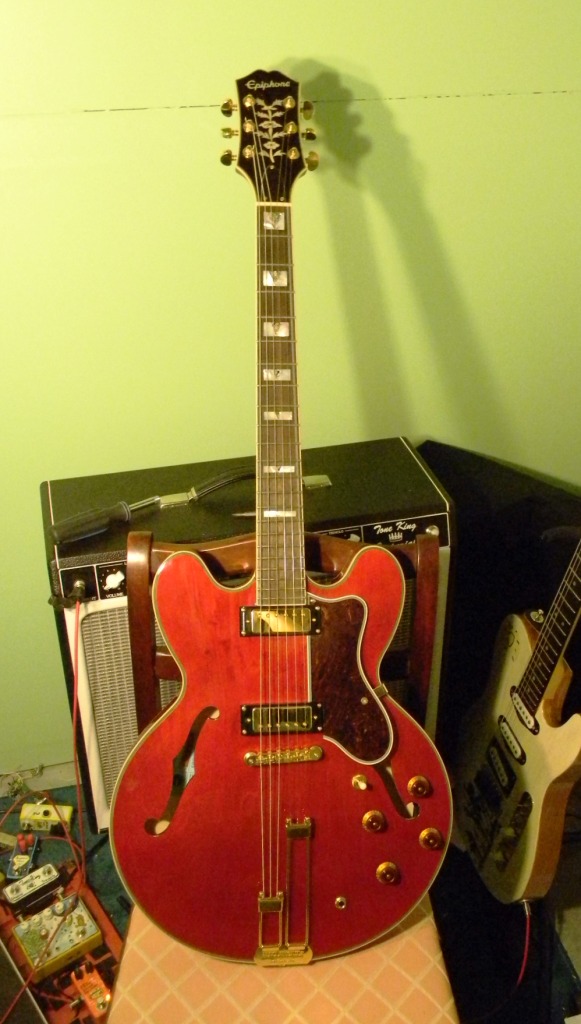
In the late 90s, when I was in high school, I had an Epiphone Sheraton II. Who knows how I paid for it at the time, because it would have been more than $500. It’s like a Gibson ES-335, a really common blues guitar. I’ve been missing it for quite some time ever since I sold it while we were saving up for the house. Then I ran across this one on Craigslist, played it, and picked it up used from a guy up near Bel Air. It’s a reproduction of a 1962 Epiphone model, and it has a different tailpiece and different pickups. It’s a much better guitar than the one I sold, but that’s not really what this post is about.
One of the reasons I was okay selling that other guitar, aside from wanting to buy a house and downsizing my “stuff,” was that I felt I had more or less moved past the kind of music that I used it for. I went from playing blues and 90s alt rock in high school to playing acoustic folk/Americana/bluegrass/old time almost exclusively, and by the time I formed up Midway Fair I was playing something more like alt-country and Celtic music. I have difficulty focusing on more than one thing and generally I’m pretentious, so my feeling that the blues was nothing but guitar wankery sort of took over. Most of the time it is. But that doesn’t mean I don’t like playing it, and ignoring that side of American music was and is, frankly, incredibly short-sighted of me, and I’d only really pull it out when it served as some sort of selling point (like describing the Midway Fair song “At the Dawn of the Day” as “blues + Celtic”).
There’s an open mic I go to about once every month or two in Ellicott City, at a place called Bippys. It used to be the open mic at The Friendly Inn, but moved when that place stopped doing live music. Since I’ve been going there almost uninterrupted (except for living out of state) since 1997, I’ve been there longer than anyone by several years. It’s a lot of blues players, and a few classic rock players. Everyone is much older than me. And most of the time I end up playing by myself, playing music that they really aren’t there to hear.
So last week, I took the new Sheraton out for its test run, and decided to whip out almost entirely new material. Paul Beckwith played bass with me, and Steve Hammond played drums. Great players — they can follow even stuff they’ve never heard. And I was forced to keep things simple.
I think it went over better than any set I’ve played there, but I noticed that most of the simplest songs I played were “solo” tunes, and that many of them were, if not exactly blues, much more blues-based than songs I played with Midway Fair. And they were fun and comfortable in a way that a lot of the Midway Fair material often isn’t.
So now I wonder. Was it the simplicity that made me think that, or is this my brain trying to tell me to keep it simple stupid?
[Oh, the guitar did fabulously for anyone curious.]
 jots on pants